
Rolls-Royce built the Spectre to prove that electric power and the marque’s founding values of silence, effortlessness, and presence were not merely compatible but ideal partners. Three years on from its 2022 introduction, Series II refines that proof with engineering updates, material innovations, and a Bespoke offering that has quietly become the most ambitious in the marque’s modern history.
Auto brands need to walk a fine line when they update their most iconic models. The goal is to change just enough to be meaningfully better without touching anything that was already right. The Spectre’s fastback profile, split headlamp signature, and clean surfacing remain exactly as Goodwood intended them. The case for changing those things did not exist, and Rolls-Royce knew it. Instead, what has changed for Series II is the substance beneath that celebrated form—and the increasingly extraordinary world of materials, craftsmanship, and individual expression available to the clients who commission one.
The Range and Performance Numbers
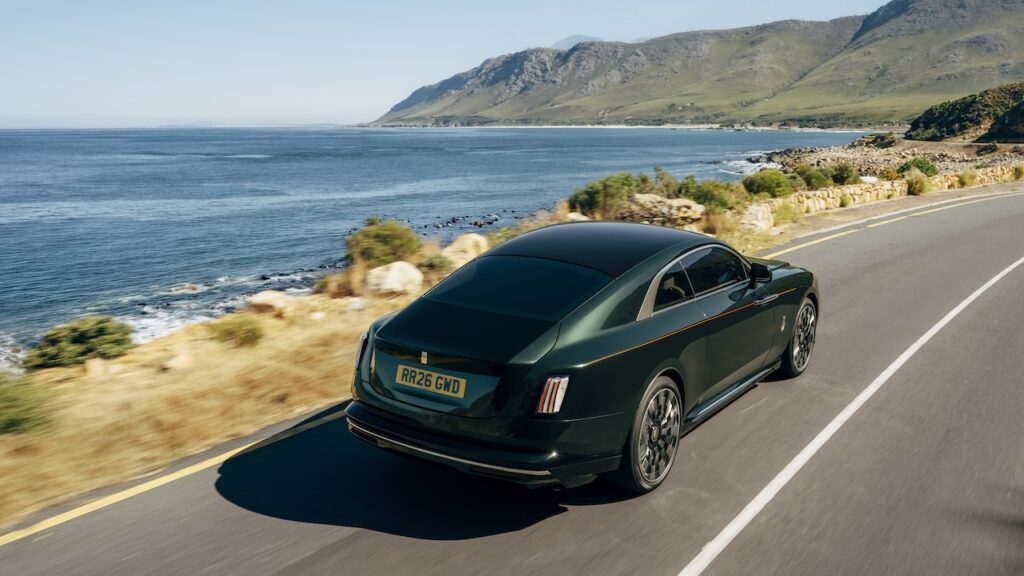
The headline update is the one that matters most for a battery-electric motor car: Spectre Series II extends its driving range by up to 18% to 390 miles on the WLTP cycle, achieved through re-engineered battery cell technology rather than an increased battery capacity. Charging times are reduced by up to 14%, which is the kind of improvement that becomes immediately visible in daily use rather than just on a specification sheet.
Power output rises to 442 kW with torque at 1,015 Nm in the standard Spectre Series II, an increase that is perceptible rather than merely statistical. In Spirited Mode, torque climbs to 1,100 Nm. These are numbers that the Goodwood engineers arrived at with the particular kind of restraint that characterises Rolls-Royce performance calibration—the objective is not maximum acceleration for its own sake but the precise delivery of immediate, silent power at the moment the driver requests it.
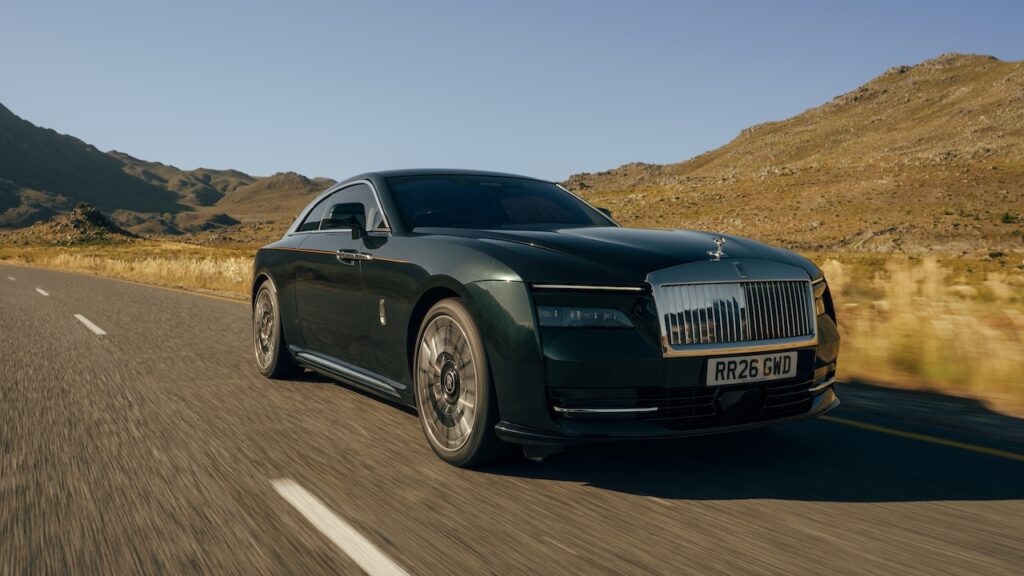
Black Badge Spectre Series II takes a different approach entirely. Infinity Mode unlocks 500 kW of power—making Black Badge Spectre Series II the most powerful Rolls-Royce ever created—while Spirited Mode summons the full 1,100 Nm torque figure. This is, in the context of what a Rolls-Royce is expected to be, a remarkable statement. The Black Badge has always existed as the marque’s alter ego: darker, more intense, less interested in ceremony. The Series II powertrain gives that character a numerical foundation to match its attitude.
For context on how clients actually use the Spectre: it is typically the second Rolls-Royce in a seven-car garage, charged almost exclusively at home, and most often driven solo. One European client has covered more than 48,000 kilometres in two years—more than three times the average annual mileage of a two-door Rolls-Royce. One Los Angeles-based collector has noted a particular pleasure of ownership: the short drive downhill from their residence to their garage below, which returns more range than it began, via regenerative braking. These are the daily realities that shaped the Series II engineering brief.
The Interior: Material Ambition at a Different Scale
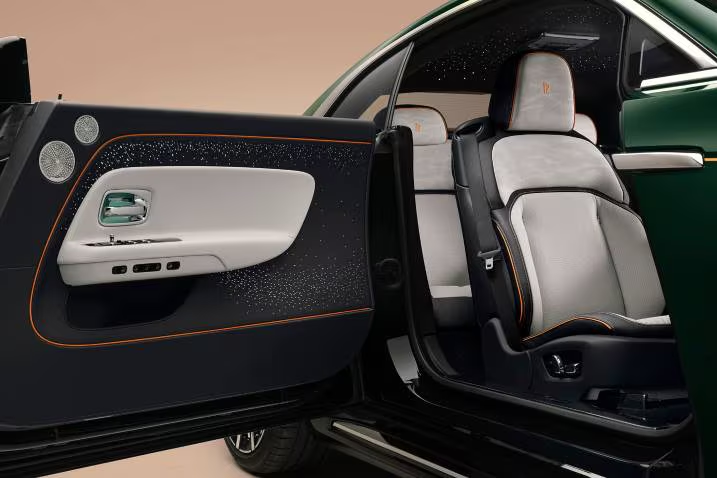
The Bespoke programme on Spectre has become, by the marque’s own description, the most ambitious in its contemporary portfolio—surpassed only by Phantom in the complexity of what clients request. Some have specified more than 20 individual Bespoke elements in a single commission. Series II expands what is possible with several new materials and crafted treatments of considerable depth.
Duality Twill is among the most distinctive. It is a rayon fabric derived from bamboo—inspired by the extensive bamboo grove at Le Jardin des Méditerranées on the Côte d’Azur, which neighbours Sir Henry Royce’s former winter home at Villa Mimosa. The embroidered graphic on the twill is an abstract interpretation of the two interlinked R initials of the marque’s founders, rendered with a nautical influence that references the rope lines of sailing yachts and adds a further, more subtle Riviera allusion. A single Duality Twill interior incorporates up to 2.6 million stitches and 10 miles of thread, requiring up to 25 hours to construct. The textile is available in Lilac, Chocolate, Black, and a new Sage—a cool, verdant green that brings a soft luminosity to the cabin.
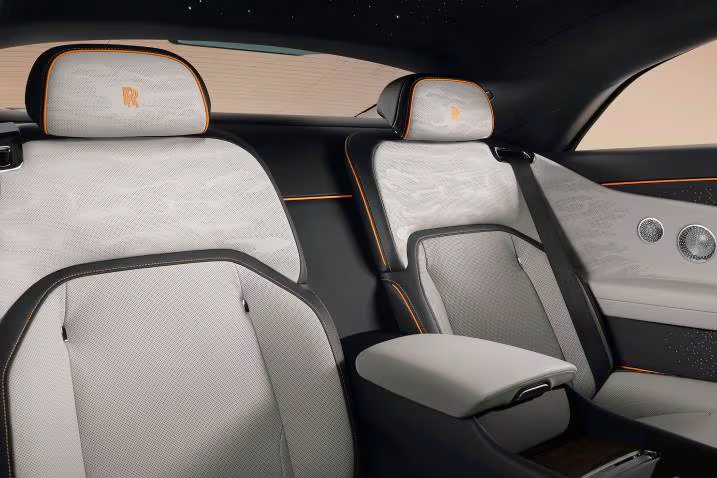
Placed Perforation leather arrives on Spectre for Series II: precision-cut patterns that reveal artworks through the leather surface. The debut design takes its inspiration from the silhouettes of clouds in moonlight, spanning the shoulder and headrest areas of all four seats through 78,138 perforations in three sizes. Where the perforation pattern extends to the illuminated door option, it subtly disperses as it approaches each light source, producing an effect described by the design team as starlight emerging through shifting night skies. It is the kind of detail that a photograph cannot fully convey.
The new Brindled Walnut veneer deserves particular attention for the process that creates it. Walnut from non-fruiting trees—which would otherwise be burned—is combined with residual eucalyptus fibres from fine paper production and compressed to create a richly layered tiger stripe pattern. The veneer is then sealed with a lacquer infused with powdered glass flakes, before a final clearcoat. The result is a surface in which shimmering particles appear suspended beneath the finish, adding depth and movement to the wood. This is Rolls-Royce applying its full material intelligence to what would otherwise be waste.
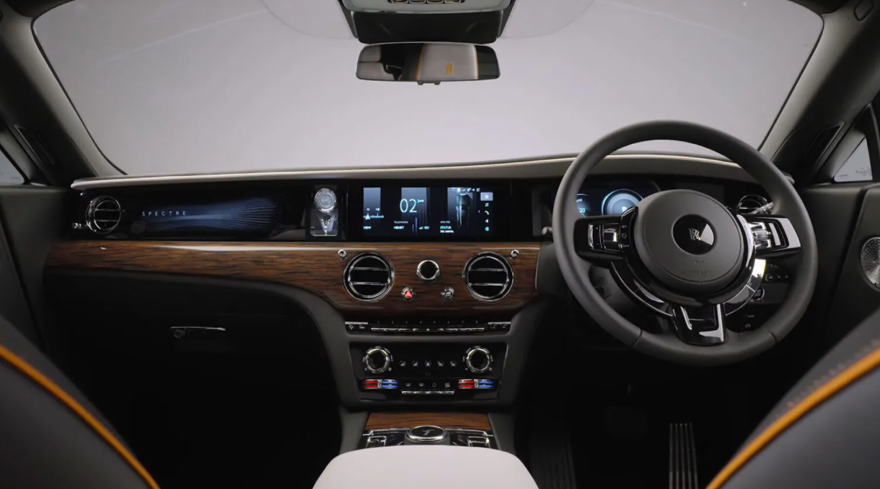
The Illuminated Fascia artwork running the full width of the dashboard comprises 8,108 individual pixel-like illuminations arranged in a directional wave pattern, drawing inspiration from the mist that settles over the South Downs woodlands beyond Goodwood. A new clock design draws on precision aviation instruments—legibility its primary purpose—housed within a vitrine that also showcases an uplit Spirit of Ecstasy in solid stainless steel.
Black Badge: Darker, Further
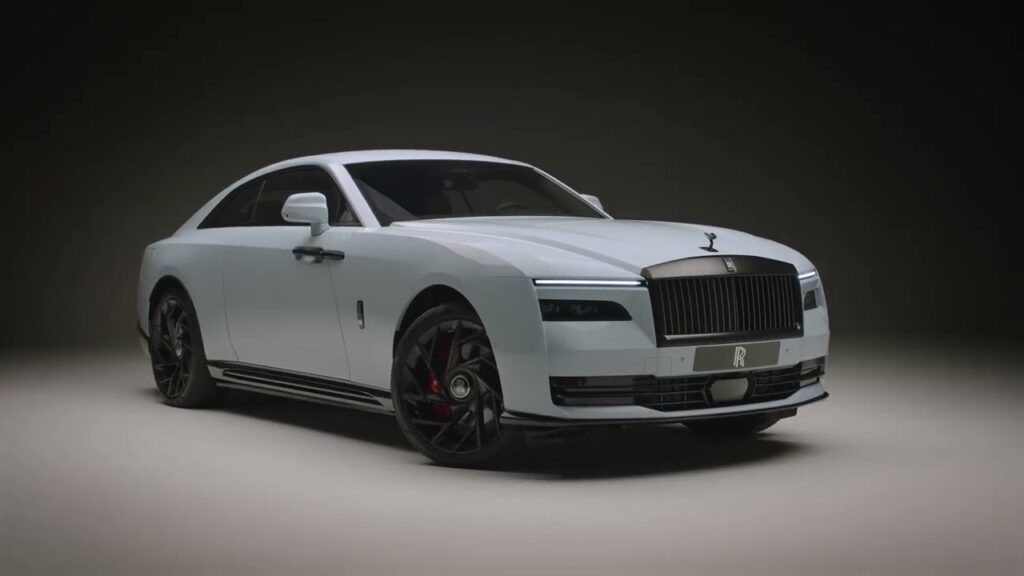
The Black Badge treatment for Series II introduces Iced Black Exterior Detailing, which transforms the motor car’s brightwork—grille surround, sideframe finishers, bumper inserts, door handles, the Spirit of Ecstasy, and the Double R Badge of Honour surround—with a matte finish achieved through a specially developed matte clearcoat. One deliberate exception: the vanes of the Pantheon Grille remain polished. Rolls-Royce designers took this decision to preserve the motor car’s identity—the grille is the face, and its polished vanes provide the contrast that prevents the exterior from becoming uniformly, uninterestingly dark.
A new wheelset specifically developed for Black Badge Spectre Series II places emphasis on the braking hardware through an open-spoke design, with a polished outer ring pushed to the very edge to accentuate diameter. Glass flakes embedded in the finish produce a fine sparkle effect. This design is available for the first time in a Black Badge wheel in Iced Matte Black, created through a specialised high-temperature curing process.
The Verdict
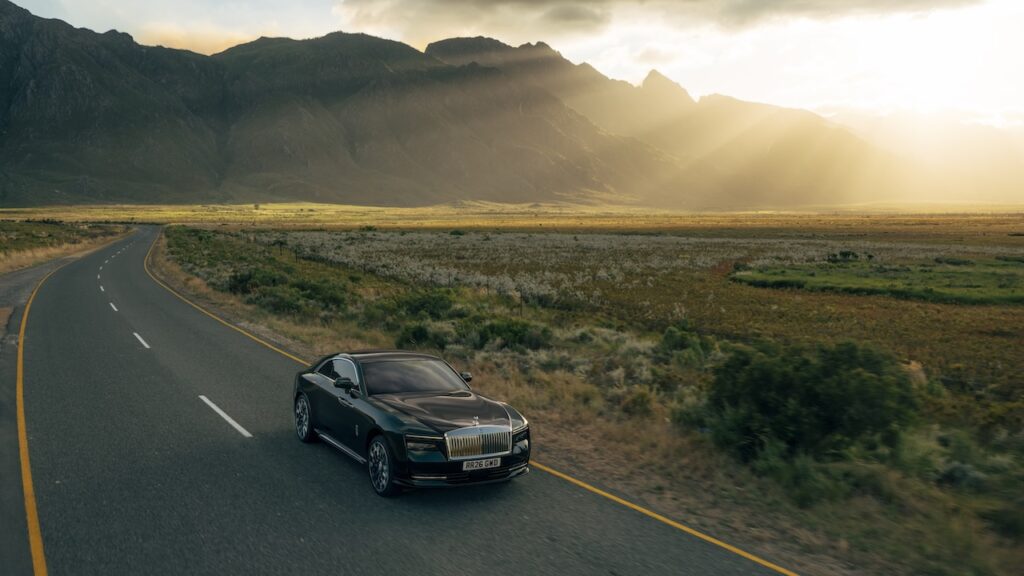
Spectre Series II is the refinement that a design confidence makes possible. The architecture is right; Rolls-Royce knows it is right; and the Series II updates address the areas where engineering progress has been made—range, charging, torque delivery—while expanding the creative possibilities for clients whose relationship with this motor car has proved to be as personal and enduring as any the marque has produced. The Bespoke commissions described by Rolls-Royce—a Starlight Headliner configured with the constellations as they appeared on the night two people first met; a marquetry portrait of a family dog named Bailey; a Korean collector’s gallery wall—suggest that the Spectre has become something more than the sum of its technical achievements. It has become, in the way that only the most considered objects manage, genuinely personal.
Series II ensures it remains worthy of that ambition